
PINEY POINT LIGHTHOUSE: HISTORY, MARITIME HERITAGE, AND VISITOR GUIDE
Standing beside the Potomac River in St. Mary’s County, Maryland, Piney Point Lighthouse is one of Southern Maryland’s most recognizable historic landmarks. Its short, sturdy brick tower has watched over the river since the 1830s, guiding commercial vessels, passenger ships, naval craft, fishermen, and other mariners traveling between the Potomac River and the Chesapeake Bay.
Today, Piney Point Lighthouse is no longer an active federal navigational station. Instead, it serves as the centerpiece of the Piney Point Lighthouse Museum and Historic Park, where visitors can explore the lighthouse grounds, learn about the people who maintained the light, examine historic vessels, and discover stories connected to the Chesapeake Bay’s maritime heritage.
The site is especially valuable because it preserves much more than a single lighthouse tower. The surrounding buildings, waterfront landscape, museum exhibits, and archaeological stories illustrate how transportation, military activity, tourism, fishing, boatbuilding, and daily life developed along the Potomac River.
For anyone interested in American lighthouses, Maryland history, family-friendly museums, or scenic destinations near Washington, D.C., Piney Point provides an accessible introduction to nearly two centuries of local and national history.
WHERE IS PINEY POINT LIGHTHOUSE?
Piney Point Lighthouse is located in the community of Piney Point in St. Mary’s County, Maryland. The site sits along the Maryland side of the lower Potomac River, approximately 14 miles upriver from the river’s entrance into the Chesapeake Bay.
This location made Piney Point an important navigational reference for vessels traveling toward Washington, D.C., Alexandria, Georgetown, and other Potomac River ports. Ships moving through the lower river had to navigate changing weather, shoals, currents, fog, and narrow channels. A dependable light at Piney Point helped mariners identify their position and avoid dangerous waters.
The lighthouse is now part of a historic park that includes museum facilities, a keeper’s residence, maritime exhibits, a pier, waterfront areas, and access for small recreational watercraft. Its setting allows visitors to experience the same river landscape that shaped the lighthouse’s operation for generations.

WHY A LIGHTHOUSE WAS NEEDED AT PINEY POINT
Before roads and railroads connected communities throughout Maryland, waterways served as the region’s most important transportation routes. Farms, plantations, fishing communities, warehouses, and towns developed along rivers because boats could carry large quantities of people and cargo more efficiently than wagons traveling over rough roads.
The Potomac River became a major commercial and political transportation corridor. Agricultural products moved downriver, while manufactured goods, tools, clothing, mail, and passengers traveled between Chesapeake ports and communities farther inland.
However, navigating the lower Potomac was not simple. Shoals near Piney Point posed a risk to ships, particularly during darkness, storms, or periods of poor visibility. A vessel that moved outside the safest channel could run aground, damage its hull, or become stranded.
A lightship reportedly served the Piney Point area before construction of the permanent lighthouse. Lightships were vessels anchored at locations where officials believed a navigational warning was necessary but where a permanent lighthouse had not yet been built. These ships carried lights that helped mariners identify hazards or important points along a route.
As river traffic increased, federal officials determined that a permanent lighthouse and keeper’s residence would provide a more dependable aid to navigation.
THE CONSTRUCTION OF PINEY POINT LIGHTHOUSE
Congress approved funding for a lighthouse at Piney Point during the 1830s. The federal government acquired land along the river, and the construction contract was awarded to John Donahoo, a Maryland builder responsible for several lighthouse projects in the Chesapeake region.
Completed in 1836, Piney Point Lighthouse was constructed as a conical brick tower. The structure is approximately 34 feet tall, making it much shorter than the dramatic coastal towers commonly associated with the Atlantic shoreline.
Its modest height was appropriate for the location. Piney Point was a river light rather than an ocean lighthouse built to project a beam across many miles of open water. The tower needed to be visible to vessels traveling through the lower Potomac, but it did not require the extreme height of a lighthouse constructed beside high cliffs or offshore reefs.
The tower’s broad, sturdy design also helped it endure strong winds, storms, moisture, and changing river conditions. Piney Point has been described as one of Maryland’s distinctive squat brick lighthouse towers because of its wide base and compact appearance.
A detached keeper’s residence was constructed near the tower. This home allowed the lighthouse keeper and the keeper’s family to live close enough to maintain the light every day and respond quickly whenever the equipment required attention.
HOW THE ORIGINAL LIGHTHOUSE WORKED
The earliest lighting system at Piney Point relied on multiple lamps and reflectors. Before the widespread adoption of advanced lighthouse lenses, keepers maintained oil-burning lamps positioned so that curved reflectors could concentrate and project their light across the water.
These systems required considerable maintenance. A lighthouse keeper had to clean soot from the lamps, polish the reflectors, trim or replace wicks, refill fuel containers, inspect the lantern room, and keep the glass clear. Even a small amount of dirt, smoke residue, or corrosion could weaken the light.
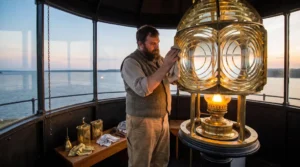
In 1855, the lighthouse received a fifth-order Fresnel lens. Fresnel lenses were among the most important technological improvements in lighthouse history. Their carefully arranged glass prisms captured and concentrated light more effectively than earlier reflector systems.
The new lens reportedly increased Piney Point’s visible range from approximately 10 miles to about 11 miles. Although that difference may seem modest, a clearer and more dependable signal could be extremely important to a ship traveling at night or during difficult weather.
The Fresnel lens also became a defining symbol of lighthouse technology. Today, lighthouse museums throughout the United States preserve these lenses as examples of precision engineering and maritime innovation.
THE DAILY LIFE OF A PINEY POINT LIGHTHOUSE KEEPER
Popular culture sometimes presents lighthouse keeping as a peaceful life spent watching sunsets beside the water. In reality, the job required discipline, physical labor, technical ability, and constant attention.
The keeper’s most important responsibility was ensuring that the light operated according to federal standards. The lamp had to be prepared before nightfall and kept functioning until daylight. During poor weather, the keeper might need to inspect the equipment repeatedly throughout the night.
Keepers maintained written logs documenting weather conditions, fuel use, repairs, vessel activity, supply deliveries, and unusual events. Government inspectors could visit the station to evaluate the tower, residence, equipment, and quality of the keeper’s work.
The lighthouse grounds also demanded regular maintenance. Keepers painted buildings, repaired fences, cleaned the tower, protected metal components from corrosion, managed fuel supplies, and maintained walkways. Family members sometimes assisted with these responsibilities, particularly at isolated stations where additional help was limited.
Life at Piney Point may have been less isolated than life at an offshore lighthouse, but the keeper still lived according to the needs of the station. Holidays, illness, storms, and family events could not interfere with the operation of the light.
THE PINEY POINT FOG BELL
A visible light could help ships during clear nights, but it was less effective when thick fog covered the river. To address this problem, a fog bell tower was added to the Piney Point station in 1880.
The bell produced an audible warning that mariners could hear even when they could not see the lighthouse. Its repeated signal helped vessel crews estimate their location and avoid nearby shoals or shoreline hazards.
Operating a fog signal created additional responsibilities for the keeper. Mechanical systems had to be maintained, wound, inspected, and repaired. During long periods of fog, the signal might operate repeatedly for hours.
The bell tower remained part of the station for decades. Hurricane Hazel caused serious damage in 1954, and the structure was later removed rather than rebuilt. Although the original fog bell tower no longer stands, its history remains an important part of the museum’s interpretation of lighthouse technology.
THE LIGHTHOUSE OF PRESIDENTS
Piney Point Lighthouse is sometimes called the “Lighthouse of Presidents.” The nickname developed because Piney Point became a popular retreat for political leaders, government officials, and prominent residents of Washington, D.C.
During the 19th and early 20th centuries, the Piney Point area attracted visitors seeking relief from the heat and activity of the capital. Before modern air conditioning, wealthy families and public figures often traveled to waterfront resorts during the summer.
The Potomac River made Piney Point relatively accessible from Washington by passenger vessel. Visitors could enjoy fishing, boating, river breezes, social events, and waterfront accommodations.
Historical accounts associate several presidents and nationally known political figures with visits to the area. This connection gave Piney Point a reputation that extended beyond its practical role as a lighthouse station.
The nickname should not distract from the experiences of the local residents, workers, watermen, hotel employees, boat crews, and lighthouse families who sustained the community. Their labor made Piney Point both a functioning maritime location and a well-known vacation destination.
PINEY POINT DURING THE CIVIL WAR
The Potomac River became strategically important during the American Civil War. Washington, D.C., lay between Maryland and Virginia, and control of the river affected military transportation, communication, commerce, and defense.
Union naval vessels patrolled the Potomac to prevent Confederate forces and sympathizers from moving supplies or disrupting traffic. Lighthouses along the river continued to serve as navigational landmarks for military and civilian vessels.
The Piney Point area witnessed wartime movement and activity because of its location near the lower river. Ships passing the lighthouse could be traveling toward the capital, naval stations, military supply points, or areas under surveillance.
One particularly tragic Civil War story associated with the waters near Piney Point is the sinking of the USS Tulip. The Union gunboat suffered a catastrophic boiler explosion in 1864 and sank in the Potomac River. Most of the crew members aboard the vessel died.
Maryland maritime archaeologists later located and investigated the wreck. The story of the USS Tulip helps visitors understand that river travel involved technological dangers as well as wartime threats.
Readers interested in another major Civil War site in St. Mary’s County can explore our complete guide to Point Lookout State Park history:
THE U-1105 BLACK PANTHER GERMAN SUBMARINE
One of the most unexpected stories interpreted at Piney Point Lighthouse Museum involves a German submarine from World War II.
The U-1105, commonly known as the Black Panther, was a German U-boat equipped with an experimental synthetic rubber coating. The material was intended to reduce the effectiveness of Allied sonar detection.
The submarine surrendered near the end of World War II and was eventually brought to the United States for testing. American authorities conducted experiments involving the vessel before sinking it in the Potomac River.
The wreck now rests beneath the river and is recognized as a historic shipwreck dive preserve. Exhibits at Piney Point explain the submarine’s technology, military history, postwar testing, and archaeological significance.
The U-1105 story expands the site’s historical timeline far beyond the construction of the lighthouse. It connects Southern Maryland to the Battle of the Atlantic, naval technology, underwater archaeology, and historic preservation.
HISTORIC BOATS AND POTOMAC RIVER WATERMEN
The Piney Point Lighthouse Museum and Historic Park includes exhibits devoted to traditional boats used along the Potomac River and Chesapeake Bay.
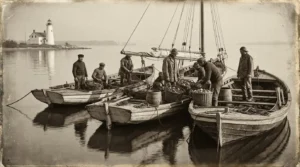
These vessels help visitors understand that maritime history was not limited to large naval ships or ocean-going cargo vessels. Small wooden boats supported fishing, crabbing, oyster harvesting, transportation, recreation, and communication between waterfront communities.
Local boatbuilders developed vessel designs suited to the shallow waters, changing weather, and working conditions of the Chesapeake region. The shape of a hull, arrangement of sails, location of equipment, and available storage space could determine whether a boat was practical for a particular occupation.
The museum’s maritime interpretation also provides opportunities to recognize the experiences of local watermen, including African American watermen whose work contributed to the region’s seafood economy and waterfront culture.
Their stories demonstrate how specialized knowledge was passed through generations. Successful watermen had to understand tides, seasons, weather, navigation, boat maintenance, fishing grounds, market prices, and environmental changes.
Visitors planning a broader exploration of St. Mary’s County maritime history can also learn about St. Clement’s Island and the founding of Maryland once that related article is published on the site.
DECOMMISSIONING THE LIGHTHOUSE
Advances in navigation gradually reduced the need for traditionally staffed lighthouse stations. Electric lights, automated systems, improved charts, radio navigation, radar, and later satellite-based technology changed how mariners identified their location.
The United States Coast Guard decommissioned Piney Point Lighthouse in 1964. The end of active service closed an important chapter that had begun when the tower was first illuminated in 1836.
However, decommissioning did not immediately transform the property into a museum. The Coast Guard continued to use some of the station buildings for housing for several years.
In 1980, the federal government transferred the lighthouse and associated property to St. Mary’s County. Preservation work eventually stabilized the historic structures and prepared the site for public interpretation.
The museum division of St. Mary’s County began developing the property as a historic attraction. Restoration allowed the lighthouse tower, keeper’s quarters, and surrounding landscape to become educational resources rather than deteriorating remnants of the past.
PINEY POINT LIGHTHOUSE MUSEUM AND HISTORIC PARK TODAY
Today, Piney Point Lighthouse Museum and Historic Park preserves the lighthouse as part of a larger maritime destination. The property is recognized as a National Register of Historic Places site and participates in the National Park Service Chesapeake Gateways network.
Visitors may be able to tour or climb the lighthouse during operating periods. Because access can be affected by staffing, maintenance, weather, special programs, and seasonal schedules, travelers should confirm current conditions before visiting.
The museum’s exhibits cover the construction and operation of the lighthouse, keeper families, the United States Coast Guard, local resort history, traditional boats, Potomac River communities, and historic shipwrecks.
The waterfront setting is also an important part of the experience. Looking across the Potomac helps visitors understand why the lighthouse was constructed at this particular location. Ships approaching from either direction would have used the light as a navigational reference.
The park also offers opportunities for picnicking, photography, shoreline observation, fishing, and small-watercraft recreation. A kayak launch connects the property with Piney Point Creek and nearby marshy waterways.
For authoritative visitor information and updates, travelers can consult the National Park Service page for Piney Point Lighthouse Museum and Historic Park:
WHAT TO SEE DURING YOUR VISIT
The lighthouse tower is naturally the main attraction, but visitors should allow enough time to explore the complete property. The tower’s compact size and brick construction provide a useful contrast to taller coastal lighthouses.
The keeper’s quarters help illustrate the domestic side of lighthouse life. These buildings remind visitors that the station was both a workplace and a home.
The maritime exhibit building contains historic boats and information about the people who worked along the Potomac River. The U-1105 exhibit introduces an unusual World War II story, while other displays cover local tourism, military activity, and Coast Guard history.
The pier and shoreline provide scenic views of the river. Wildlife sightings may include ospreys, herons, gulls, and other birds associated with the Chesapeake watershed.
Photography is especially appealing during mornings and late afternoons, when lower sunlight can create dramatic views of the brick tower, white keeper’s buildings, shoreline, and Potomac River.
TIPS FOR PLANNING A PINEY POINT LIGHTHOUSE VISIT
Check the official museum schedule before traveling because operating hours, admission policies, lighthouse access, and special events may change throughout the year.
Wear comfortable shoes suitable for historic buildings, outdoor paths, and waterfront areas. Visitors interested in climbing the tower should be prepared for narrow stairs and confined spaces.
Bring sun protection during warmer months because portions of the property are exposed. Families may also wish to bring water and allow additional time for the museum, maritime exhibits, park grounds, and river views.
Visitors using wheelchairs or mobility devices should review current accessibility information before arriving. Historic lighthouse towers often present physical limitations even when surrounding museum buildings and grounds offer accessible areas.
Weather conditions can change quickly near the river. Wind, rain, extreme heat, and storms may affect outdoor activities, lighthouse access, kayaking, or waterfront programs.
NEARBY HISTORIC ATTRACTIONS
Piney Point Lighthouse can be included in a larger St. Mary’s County history itinerary. St. Clement’s Island Museum in Coltons Point interprets Maryland’s 1634 colonial landing and the cultural history of the Potomac River.
Historic St. Mary’s City preserves the site of Maryland’s first capital and offers reconstructed buildings, archaeology, living-history programs, and the Maryland Dove.
Point Lookout State Park lies near the southern end of the county. Its history includes a lighthouse, Civil War hospital, prisoner-of-war camp, military installations, and coastal recreation.
Travelers interested in African American history can also visit the Drayden African American Schoolhouse, a preserved one-room school that helps document education during segregation.
Combining these sites gives visitors a broader understanding of how Indigenous history, colonization, slavery, maritime labor, military conflict, education, and environmental change shaped Southern Maryland.
WHY PINEY POINT LIGHTHOUSE MATTERS
Piney Point Lighthouse matters because it connects many different parts of American history within one waterfront landscape.
Its tower represents the federal government’s efforts to make river transportation safer during the 19th century. The keeper’s quarters preserve the experiences of families whose daily work supported navigation. The fog bell story demonstrates how technology adapted to difficult weather.
The surrounding community reflects the history of Potomac River resorts and the political figures who traveled from Washington. Civil War and World War II exhibits connect the location to national and international military events.
Traditional boats and watermen’s stories document the labor that sustained Chesapeake communities. Archaeological research involving shipwrecks shows how historians continue discovering and interpreting the past beneath the river.
Preserving the lighthouse also protects an important part of the Chesapeake Bay landscape. Historic buildings gain greater meaning when visitors can still see the waterways, shorelines, and natural features that influenced their construction.
EXPERIENCE PINEY POINT LIGHTHOUSE HISTORY
Piney Point Lighthouse is more than a scenic brick tower beside the Potomac River. It is a gateway to the maritime history of St. Mary’s County and the broader Chesapeake Bay region.
From its construction in 1836 through its decommissioning in 1964, the lighthouse helped generations of mariners navigate one of America’s most historically important rivers. Today, the museum and historic park preserve the people, vessels, technologies, and communities connected to that service.
A visit offers a chance to climb a historic lighthouse, examine traditional boats, learn about lighthouse keepers, explore military shipwreck stories, and enjoy the peaceful waterfront environment.
Whether you are researching Maryland history, planning a Southern Maryland road trip, or searching for historic places near Washington, D.C., Piney Point Lighthouse provides a memorable connection to America’s maritime past.