Leonardtown Wharf Park and the Waterfront History of Southern Maryland
Leonardtown Wharf Park is more than a scenic place to watch boats move across Breton Bay. The waterfront represents centuries of St. Mary’s County history, from Indigenous communities and colonial commerce to wartime raids, steamboat transportation, entertainment, environmental restoration, and modern recreation. Today, the park allows visitors to experience that history while walking along the waterfront, launching a kayak, attending a community event, or simply looking across the same waters that once connected Leonardtown with the wider Chesapeake region.
Located at the end of Washington Street in Leonardtown, Maryland, the park occupies a waterfront that once functioned as one of the town’s most important connections to the outside world. Before automobiles and modern highways transformed transportation, waterways served as essential routes for people, agricultural products, manufactured goods, news, and commerce. Leonardtown’s location at the head of Breton Bay gave the community access to the Potomac River and the larger Chesapeake transportation network.
Understanding Leonardtown Wharf Park therefore means looking beyond the modern playground, boardwalk, docks, and lawns. The landscape tells a much longer story about why communities developed beside waterways and how changes in transportation reshaped Southern Maryland.
A Waterfront With Thousands of Years of Human History
The history of Breton Bay began long before Leonardtown existed.
Archaeological interpretation at the Wharf notes that people have occupied the Breton Bay area for thousands of years. During earlier periods, lower sea levels created a shoreline different from the landscape seen today. The region provided abundant natural resources that supported Indigenous communities long before European settlement transformed Southern Maryland.
Water shaped those communities just as it later shaped colonial settlement.
Rivers and bays supplied fish, shellfish, plants, transportation routes, and access to neighboring settlements. Archaeological evidence across the Chesapeake region demonstrates that waterways were central parts of Indigenous cultural and economic landscapes rather than boundaries separating communities.
That long human history provides important context for Leonardtown Wharf Park. The park may appear to be a relatively modern recreational space, but people have interacted with the surrounding water and shoreline for generations extending far beyond Leonardtown’s colonial founding.
Recognizing this earlier history also expands the story of St. Mary’s County. Colonial landmarks represent only one chapter of a landscape shaped first by Indigenous peoples and later by European settlement, African American labor and community life, maritime industries, war, transportation, and environmental change.
The Founding of Leonardtown
Leonardtown traces its official establishment to 1708, although European settlement and county government activity in the surrounding area began earlier.
The town developed at the head of Breton Bay, where access to water made the location useful for commerce and public business. Historical accounts describe the establishment of a 50-acre town divided into lots, with land reserved for a county courthouse. The community was initially associated with names including Seymour Town before becoming Leonard Town in 1728, honoring Benedict Leonard Calvert, then governor of Maryland.
Leonardtown eventually became the county seat of St. Mary’s County, strengthening the connection between government, commerce, and the waterfront.
Residents traveling to town for court proceedings or business could also participate in trade. Farmers in surrounding areas needed routes to move agricultural products to larger markets. Merchants needed access to imported goods. Water transportation provided those connections long before paved roads became practical for large-scale commercial movement.
The wharf consequently became a significant part of Leonardtown’s development.
 Leonardtown Wharf and Colonial Trade
Maryland’s colonial economy depended heavily on waterways.
In the seventeenth century, many ships stopped directly at plantation wharves to collect tobacco and deliver goods imported from England, the Caribbean, and elsewhere in the Atlantic world. Colonial officials eventually sought more centralized control over trade so that duties and taxes could be collected more effectively.
A Maryland law adopted in 1685 designated certain locations as legal ports for commerce. The area associated with Breton Bay and the settlement that later became Leonardtown was among the designated trading locations in St. Mary’s County.
Tobacco became particularly important.
The crop influenced land use, labor systems, shipping patterns, wealth, and politics across Southern Maryland. Its production relied heavily on enslaved labor, making the commercial success of Chesapeake ports inseparable from the history of slavery.
Ships departing local wharves carried agricultural products to distant markets while imported manufactured goods entered the region through the same maritime network.
Leonardtown’s waterfront connected a relatively small community with a much larger Atlantic economy.
The Wharf therefore represents more than transportation history. It provides an opportunity to examine agriculture, slavery, international trade, taxation, local government, and the economic systems that shaped colonial Maryland.
The War of 1812 Reaches Leonardtown
One of the most dramatic events associated with Leonardtown Wharf occurred during the War of 1812.
Southern Maryland experienced repeated British military activity because its rivers provided convenient access to inland communities. British forces operating in the Chesapeake attacked settlements, disrupted commerce, confiscated supplies, and damaged agricultural operations. The National Park Service notes that Southern Maryland experienced extensive raids and economic damage during the Chesapeake Campaign.
Leonardtown became one of the communities directly affected.
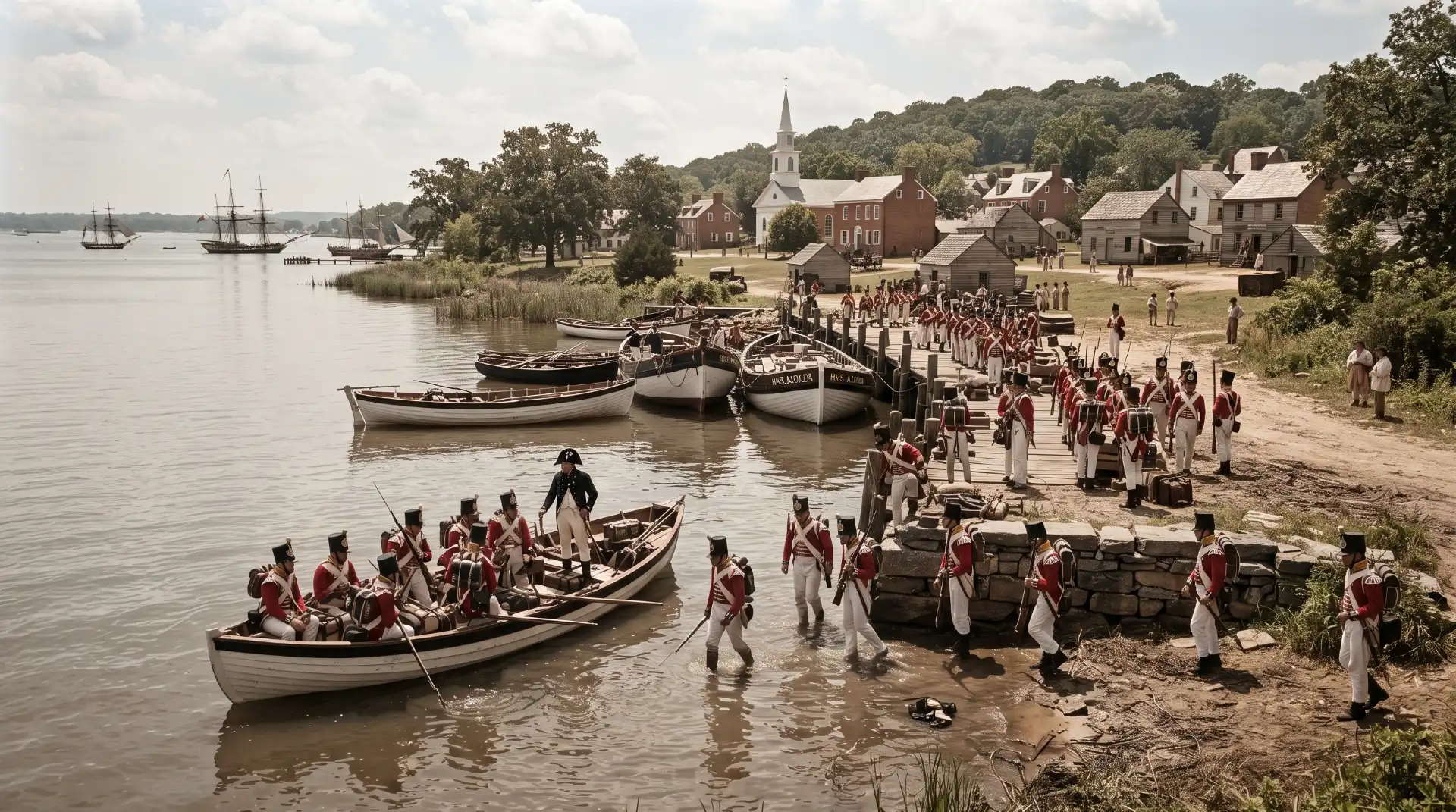
On July 19, 1814, British forces entered the area in an attack involving approaches by both land and water. Historical interpretation at the Wharf describes approximately 1,500 British troops participating in the operation. Rear Admiral George Cockburn led the British campaign in the region.
The attackers seized supplies that included tobacco, flour, weapons, and a small vessel. Despite the overwhelming British force, the town itself escaped large-scale destruction.
Today, visitors can stand near Breton Bay and imagine military boats approaching the waterfront more than two centuries ago.
That geographic perspective makes the story particularly powerful.
The War of 1812 can sometimes seem distant when studied only through documents or battlefield maps. Standing beside the water shows why Leonardtown was vulnerable. Breton Bay offered direct access into a community that depended on maritime commerce.
Leonardtown Wharf Public Park is now recognized as a partner site associated with the National Park Service’s Star-Spangled Banner National Historic Trail. The trail connects sites throughout Maryland, Virginia, and Washington, D.C., associated with the Chesapeake Campaign and the events surrounding the creation of the national anthem.
For visitors interested in extending their exploration of Southern Maryland’s military history, SMC History’s guide to Point Lookout State Park examines another St. Mary’s County landscape shaped by conflict, military occupation, and maritime geography.
The Waterfront During the Civil War Era
Leonardtown’s maritime importance continued during the Civil War.
Southern Maryland occupied a complicated political and geographic position. Maryland remained in the Union, while Confederate sympathies existed in parts of the state. Leonardtown’s location near navigable waterways attracted federal attention as authorities attempted to control movement and prevent supplies from reaching Confederate networks.
Town history records Union naval activity and searches for weapons and supplies during the conflict. Historical interpretation at the Wharf also documents smuggling cases involving contraband moving through Leonardtown’s waterfront.
The period after the Civil War brought additional changes.
Reconstruction altered political, economic, and social relationships throughout Southern Maryland. The Freedmen’s Bureau operated in the region as formerly enslaved people sought education, employment, family reunification, legal recognition, and greater control over their lives.
Commerce at Leonardtown Wharf continued as the local economy adjusted to a country transformed by emancipation and war.
By the late nineteenth century, new industries were using the wharf as well. Historical interpretation notes that bricks produced in Leonardtown were shipped from the waterfront to markets as far away as North Carolina.
The wharf had evolved beyond its colonial role, but water remained one of Leonardtown’s most valuable transportation resources.
The Golden Age of Steamboats
The late nineteenth and early twentieth centuries brought another major chapter in Leonardtown Wharf history.
Steamboats transformed travel around the Chesapeake.
Before widespread automobile ownership and improved highways, steam-powered vessels provided a practical way to move passengers and cargo among waterfront communities. Leonardtown became a regular steamboat landing connected with destinations throughout the Chesapeake region.
A deeper channel was created in the late nineteenth century to improve access for steamboat traffic. These vessels brought manufactured goods, visitors, mail, news, and new forms of entertainment while carrying local products to outside markets.
For residents of rural Southern Maryland, the arrival of a steamboat could become a community event.
Passengers stepped ashore. Merchants received shipments. Farmers sent products to market. Families greeted visitors. Travelers continued toward Washington, Baltimore, Philadelphia, and other destinations.
The waterfront became a gateway between Leonardtown and a rapidly changing United States.
The experience was very different from modern highway travel. Transportation schedules depended on waterways, weather, navigation conditions, and access to suitable landings.
Leonardtown Wharf stood at the center of this system.
When Entertainment Arrived by Water
Commerce was not the only attraction at Leonardtown’s waterfront.
During the late nineteenth and early twentieth centuries, the Wharf also became a place for recreation and entertainment. Historical interpretation describes swimming, picnics, boating parties, touring performances, and visitors arriving aboard steamships.
One of the most memorable attractions was a floating theater.
The James Adams Floating Theatre docked at Leonardtown and presented theatrical performances to local audiences. The venue was part of a broader tradition of showboats bringing entertainment to communities connected by navigable rivers and bays.
Author Edna Ferber later spent several days aboard the floating theater while researching the world that contributed to her famous novel Show Boat. Historical interpretation at Leonardtown Wharf connects people associated with the floating theater to characters that later appeared in Ferber’s work.
This chapter gives the Wharf a cultural history as well as an economic one.
The waterfront was where residents could encounter people, fashions, entertainment, technology, and ideas arriving from larger cities.
It also illustrates how important water transportation remained before cars changed everyday movement.
Roads and Automobiles Change the Waterfront
The popularity of steamboat transportation gradually declined as roads, automobiles, trucks, and other transportation systems improved.
People no longer depended on scheduled vessels to reach nearby cities or transport everyday goods. Commercial activity shifted away from many traditional waterfront landings.
Across the Chesapeake, numerous wharves that once served as busy commercial centers became less important.
Leonardtown experienced the same transition.
The Wharf’s declining commercial role created a new question for the community. What should happen to a waterfront that no longer served the same economic purpose?
The eventual answer involved transforming the former working waterfront into a public space.
Leonardtown’s current comprehensive planning materials describe Wharf Park as a reimagining of the town’s former commercial waterfront into a signature recreational and community asset.
That transformation created a new chapter while preserving public access to Breton Bay.
 From Working Wharf to Public Park
Modern Leonardtown Wharf Park reflects a broader preservation idea that has appeared in many American waterfront communities.
A historic waterfront does not need to remain an industrial site to preserve its significance.
Instead, public parks can maintain access to water while interpreting the earlier history of trade, transportation, war, and community life.
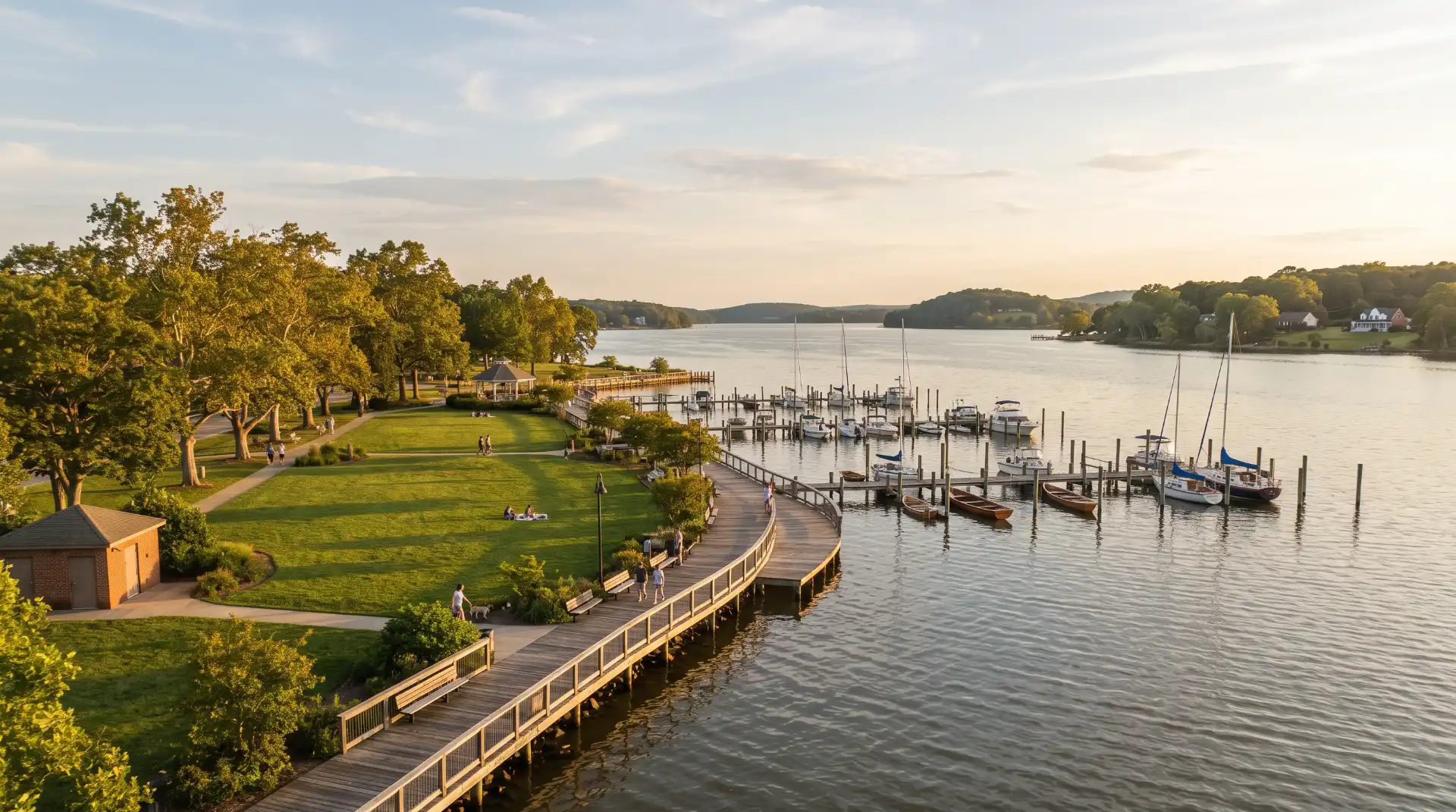
Leonardtown’s Wharf now includes landscaped open space, waterfront paths, docking facilities, public restrooms, a playground, boating access, and areas used for gatherings and community events.
Historical markers placed around the property help visitors understand what happened on the same ground.
The result is a park where recreation and historical interpretation exist side by side.
A family may visit because children want to use the playground. A paddler may arrive to access Breton Bay. Another visitor may come specifically to study War of 1812 history.
Each experience takes place within the same historic waterfront landscape.
Exploring Breton Bay From the Water
One of the best ways to understand Leonardtown’s history is from Breton Bay itself.
The park provides access for kayaking, canoeing, paddleboarding, and small boating activities. Boat slips and a floating dock extend the park’s connection with the water. The tourism office also identifies free boat tie-ups and kayak access among the waterfront amenities.
Paddling changes the visitor’s perspective.
From land, Breton Bay can appear peaceful and relatively contained. From the water, it becomes easier to understand how the bay functioned as a transportation corridor.
For centuries, travelers approaching Leonardtown often saw the town from the water before entering it from land.
A modern kayak therefore follows a landscape once traveled by Indigenous watercraft, sailing vessels, military boats, commercial ships, steamboats, fishing vessels, and recreational craft.
That continuity makes water recreation particularly appropriate at Leonardtown Wharf Park.
The Environmental Story of the Modern Park
Leonardtown Wharf Park also reflects modern efforts to balance public waterfront access with Chesapeake Bay environmental protection.
Land near tidal waters plays an important role in water quality and wildlife habitat. Development around Chesapeake tributaries can affect erosion, runoff, vegetation, wetlands, and aquatic ecosystems.
Interpretive material at Leonardtown Wharf discusses Maryland’s Critical Area approach to managing land near tidal waterways. The modern park was designed within this environmentally sensitive setting while still accommodating recreation and public access.
Breton Bay supports a living ecosystem rather than serving merely as a scenic backdrop.
Fish, birds, turtles, shellfish, aquatic plants, and other organisms depend on the relationship between land and water. Modern restoration efforts in the bay, including oyster-related projects highlighted through local interpretation, connect environmental history with the community’s maritime past.
The environmental story adds another historical layer.
Earlier generations used Breton Bay primarily as a transportation route and source of natural resources. Modern visitors increasingly encounter the waterfront as a place where recreation, conservation, education, and history overlap.
 What Visitors Can Do at Leonardtown Wharf Park Today
Leonardtown Wharf Park currently functions as one of the town’s main public gathering places.
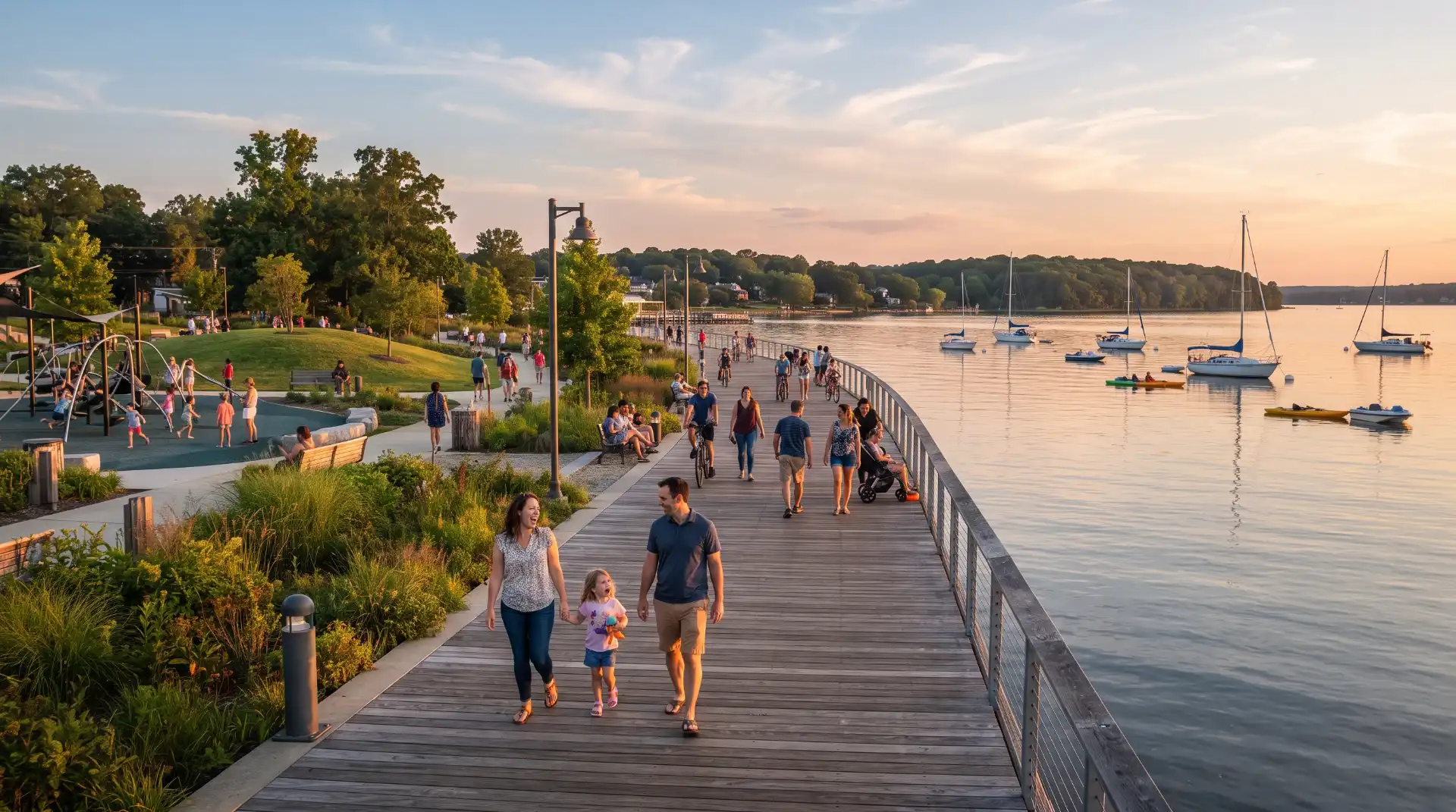
Visitors can stroll along the waterfront, sit beside Breton Bay, use picnic areas, explore the boardwalk, watch boats, or spend time with family near the playground. Water activities include kayaking, canoeing, paddleboarding, and boating access.
Community programming has also become an important part of the Wharf.
The park hosts music events, arts markets, boating activities, and other public gatherings throughout the year. Because schedules change, travelers should consult official Leonardtown or St. Mary’s County visitor information before planning around a specific event.
The park’s location also makes it easy to combine a waterfront visit with downtown Leonardtown.
Washington Street connects the Wharf with Leonardtown’s historic center, where visitors can explore restaurants, shops, historic buildings, and other community attractions.
Connecting Leonardtown Wharf With Other St. Mary’s County History
Leonardtown Wharf Park makes a useful starting point for exploring the broader maritime history of St. Mary’s County.
Travel south through the county and waterways remain part of nearly every major historical story.
Piney Point, for example, became an important navigation point along the Potomac River. Its lighthouse helped guide maritime traffic through waters used by commercial vessels, military ships, fishing boats, and regional travelers.
Readers can explore that history in our Piney Point Lighthouse history and visitor guide.
Farther south, Point Lookout occupies the peninsula where the Potomac River meets the Chesapeake Bay. Its location influenced military strategy, navigation, transportation, and the development of the Civil War prison camp located there.
Our complete guide to Point Lookout State Park history provides another way to understand the relationship between Southern Maryland history and its waterways.
Together, Leonardtown Wharf, Piney Point, and Point Lookout reveal a consistent theme.
Water shaped St. Mary’s County.
Why Leonardtown Wharf Park Matters
Leonardtown Wharf Park matters because it preserves access to a landscape that helped create the town around it.
The water once brought tobacco ships and imported goods. British troops approached during the War of 1812. Steamboats connected residents with distant cities. Floating theaters brought entertainment to local audiences. Commercial vessels moved agricultural and industrial products. Eventually, automobiles reduced the Wharf’s transportation importance.
Instead of disappearing entirely behind private development, the waterfront became a public park.
Today, visitors can stand beside Breton Bay and encounter many of those historical layers in one place.
The playground, docks, boardwalk, lawns, historical markers, and recreational activities represent the present. The shoreline, water, and surviving historical memory connect that present with earlier generations.
For travelers interested in Maryland history, Leonardtown Wharf Park offers something different from a traditional museum.
The landscape itself is the primary exhibit.
Looking across Breton Bay provides a clearer understanding of why Leonardtown developed where it did, why the British targeted the community, why steamboats stopped here, and why the waterfront remains significant even after its commercial era ended.
A Waterfront Where Leonardtown’s Past Meets Its Present
Leonardtown Wharf Park demonstrates how a community can reuse a historic landscape without separating it from its past.
The Wharf no longer serves as the commercial gateway it once was. Goods do not arrive aboard Chesapeake steamboats, and travelers no longer wait on the waterfront for transportation to distant cities.
Yet Breton Bay still defines the experience of the place.
People come to paddle, walk, gather, attend events, photograph sunsets, study historical markers, or spend time beside the water. Those activities create a modern community space on ground shaped by centuries of transportation and trade.
For anyone exploring St. Mary’s County, Leonardtown Wharf Park provides an accessible introduction to Southern Maryland’s maritime identity.
A visit can begin as a quiet walk beside Breton Bay and become a journey through Indigenous history, colonial commerce, the War of 1812, Civil War tensions, steamboat travel, American entertainment history, environmental conservation, and waterfront preservation.
Few places illustrate Leonardtown’s relationship with the water as clearly.
The Wharf once connected the town to the wider world through ships. Today, Leonardtown Wharf Park connects visitors with the many generations that shaped this historic Southern Maryland waterfront.