
San Mateo County’s history is closely connected to transportation. Long before modern highways carried thousands of commuters across the Peninsula each day, the region depended on trails, wagon roads, waterways, stage routes, and eventually railroads to connect its communities with San Francisco and other parts of California. The county’s geography made transportation both necessary and difficult. The Santa Cruz Mountains, Pacific coastline, forests, creeks, marshes, and valleys created natural barriers, while the region’s growing population and expanding economy created an increasing demand for reliable ways to move people and goods.
Transportation did not simply respond to the growth of San Mateo County. It helped create that growth. Roads opened access to the redwood forests, allowing timber companies to move lumber toward Redwood City and San Francisco. Railroads later made it easier for people to travel between the Peninsula and San Francisco, encouraging new residential communities and changing the way people thought about commuting. Streetcars extended transportation into more neighborhoods, automobiles created new possibilities for suburban development, and highways eventually connected San Mateo County to the wider Bay Area. Each transportation era left its own mark on the county’s landscape.
Today, many of these historical changes are easy to overlook. Modern residents can travel from one Peninsula community to another without thinking about the difficult journeys that were once required. Yet many present-day roads, neighborhoods, commercial districts, railroad corridors, and communities owe their locations and development to transportation routes established more than a century ago. From the redwood forests in the western part of the county to the railroad lines running through the eastern Peninsula, transportation has been one of the forces that shaped San Mateo County into the place it is today.
San Mateo County Before the Railroad
When San Mateo County was established in 1856, transportation was very different from what residents experience today. The area included ranches, farms, forests, small settlements, coastal communities, and large undeveloped areas. Roads were generally unpaved, travel could be slow, and difficult terrain frequently affected where people could go. A trip that takes minutes by car today could require hours by horse or wagon in the nineteenth century, particularly when travelers had to cross muddy roads, steep hills, streams, or mountain passes.
The geography of the Peninsula created some of the greatest transportation challenges. San Mateo County stretches from San Francisco Bay on the east to the Pacific Ocean on the west, with the Santa Cruz Mountains running through its central and southern portions. Communities on opposite sides of the mountains could be relatively close geographically while remaining difficult to reach. The Coastside presented another challenge because of steep cliffs, rugged hills, and coastal terrain. These geographical conditions meant that transportation routes were rarely established simply by drawing a straight line between two communities. Roads and later railroads had to follow valleys, slopes, passes, and other areas where construction was possible.
At the same time, the region possessed natural resources that created a strong reason to improve transportation. Among the most important were the enormous redwood forests that covered portions of the Peninsula. As San Francisco expanded following the Gold Rush, demand for lumber increased dramatically. Buildings, homes, businesses, docks, streets, and other structures required enormous quantities of wood. The redwoods of San Mateo County were relatively close to the growing city, but their economic value depended on the ability to transport the timber from the mountains to markets.
This created an early connection between natural resources and transportation. A redwood tree standing deep in the forest could not contribute much to the regional economy unless workers could cut it, process it, and move it. Roads, wagons, animals, mills, and waterways therefore became essential parts of the county’s early economic system. The transportation network developed around the movement of lumber helped establish some of the commercial patterns that would influence San Mateo County for decades.
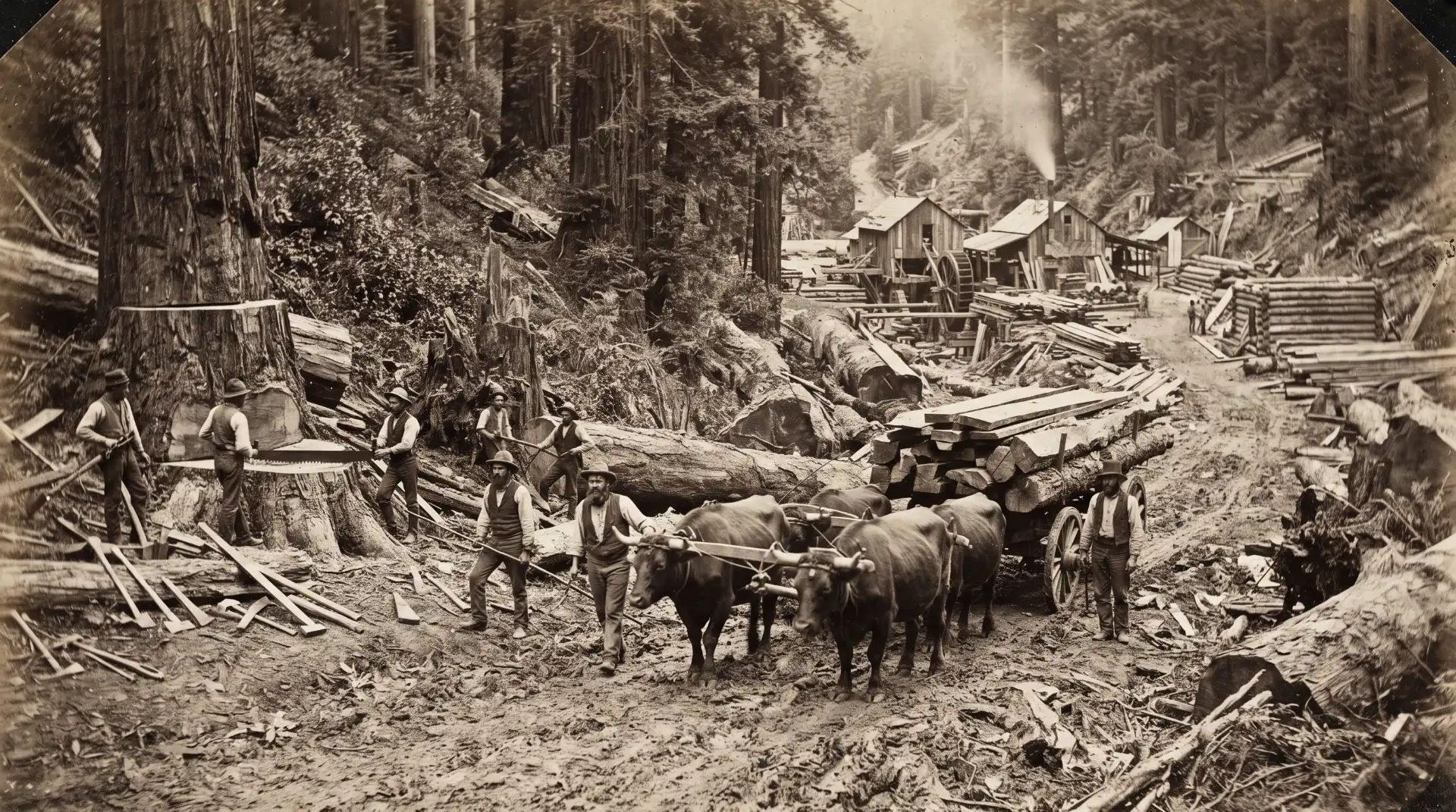
Redwood Logging and the Early Transportation Network
During the middle of the nineteenth century, logging became an important part of the Peninsula economy. Workers entered the redwood forests with tools and equipment that were primitive compared with modern logging machinery. Trees were cut by hand, processed near the forests, and then moved toward communities where the lumber could be sold or shipped. The work was physically demanding, and transporting heavy timber through mountainous terrain was one of the biggest challenges facing the industry.
Oxen and heavy wagons were particularly important. Teams of animals could pull loads of lumber along rough mountain roads toward Redwood City, where the timber could then be transferred toward the waterfront and eventually transported to San Francisco. San Mateo County’s history of Huddart Park preserves evidence of this early logging period, including the development of sawmills and transportation routes used to move lumber out of the forest. The county notes that several sawmills operated in the area during the 1850s and that oxen were used to haul lumber toward Redwood City. San Mateo County Parks provides additional historical information about this period.
The importance of these early roads extended beyond the logging industry. Once a road existed, other travelers could use it as well. Farmers could move agricultural products, residents could reach nearby communities, and businesses could receive supplies more easily. A transportation route created for one economic purpose could therefore become part of a broader network serving an entire region. This pattern would appear repeatedly throughout San Mateo County’s history.
Redwood City benefited significantly from its position within this system. Its location near Redwood Creek and San Francisco Bay gave the community an important connection between the interior Peninsula and the larger regional market. Lumber could move from the forests toward the city and then continue by water toward San Francisco. The relationship between the forests, roads, waterfront, and urban markets helped Redwood City develop into an important commercial center.
This early transportation system was still limited, however. Moving people and goods by wagon was slow and expensive, particularly over mountainous roads. As San Francisco continued to grow, the demand for a faster and more reliable transportation connection between the city and the Peninsula became increasingly important. The solution would come in the form of a technology that was transforming transportation across the United States: the railroad.
The Railroad Changes the Peninsula
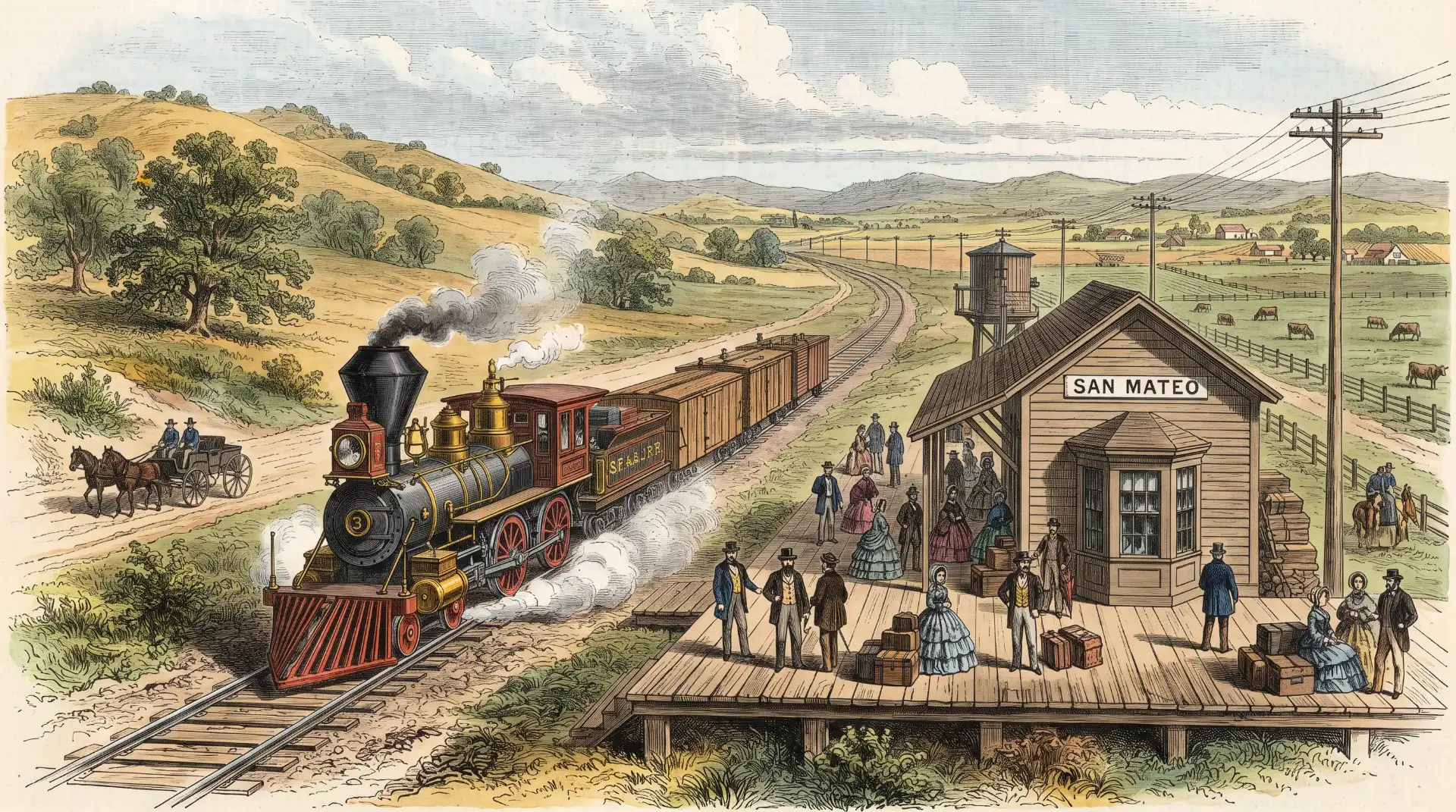
The arrival of the railroad in San Mateo County during the nineteenth century represented one of the most important transportation changes in the region’s history. The San Francisco and San Jose Railroad reached the Peninsula in the 1860s, establishing a more dependable connection between San Francisco and communities to the south. The railroad reduced travel times and made movement between communities considerably easier than it had been by stagecoach or wagon.
The impact of the railroad went far beyond faster travel. It changed the economic and social geography of the Peninsula. Before rail service, distance from San Francisco was a significant obstacle for people who wanted to live outside the city while maintaining regular connections with it. Once railroad service became available, that relationship began to change. Communities along the railroad could increasingly participate in the economic life of San Francisco while retaining their own local identities.
The railroad also helped create new opportunities for residential development. Wealthy San Franciscans began establishing estates and homes on the Peninsula, taking advantage of the railroad connection to the city. At the same time, communities along the line gained access to new markets and commercial opportunities. Railroad stations became important points around which local activity developed, and roads increasingly connected surrounding neighborhoods and farms with those stations.
The change was gradual, but the basic pattern of Peninsula suburbanization had begun. People did not necessarily have to live immediately beside their workplace anymore. Instead, they could live farther away and travel regularly along the railroad corridor. This idea would eventually become a defining characteristic of San Mateo County, where large numbers of residents would live in one community while working, shopping, studying, or conducting business somewhere else.
The railroad also influenced the movement of goods. Agricultural products, lumber, construction materials, and other commodities could reach markets more efficiently. The railroad therefore reinforced the transportation relationship that had already developed between San Mateo County and San Francisco. Instead of depending primarily on wagons and ships, the county now had another major transportation system capable of moving people and freight across the Peninsula.
The importance of the railroad can still be seen today because the historic Peninsula rail corridor remains part of the modern transportation landscape. Although the equipment and technology have changed dramatically, the basic north-south connection established during the nineteenth century continues to influence how residents travel between San Francisco, San Mateo County, and the South Bay.
Streetcars Expand Local Mobility
Railroads provided an important regional connection, but another transportation revolution eventually made travel even more accessible. Electric streetcars began expanding across the Peninsula around the beginning of the twentieth century. Unlike long-distance railroad trains, streetcars could make frequent stops and serve neighborhoods located away from major railroad stations. This allowed transportation to reach a larger portion of the population.
The growth of streetcars had a significant influence on residential development. A neighborhood did not need to be located directly beside a major railroad station to benefit from public transportation. A streetcar line could connect residential streets with downtown districts, railroad stations, workplaces, schools, and shopping areas. As a result, communities could expand outward while remaining connected to established commercial centers.
Streetcars also helped make commuting more practical for middle-class residents. The San Mateo County Historical Association’s transportation exhibits describe how streetcar service expanded the number of people who could travel regularly between Peninsula communities and San Francisco. Lower fares and more frequent stops made local and regional travel accessible to a broader population than the early railroad system had been.
This transportation expansion changed the daily rhythm of life. Residents could increasingly think of the Peninsula as a connected region rather than a series of isolated settlements. Someone could live in one community, work in another, shop somewhere else, and still return home within the same day. The transportation system was creating a more interconnected social and economic landscape.
Streetcar routes also influenced the appearance of communities. Commercial businesses often benefited from locations along transportation corridors because passing passengers created additional customers. Residential development followed established routes, while existing town centers became more accessible to surrounding neighborhoods. Many of the patterns established during this period would continue to influence development even after streetcars disappeared.
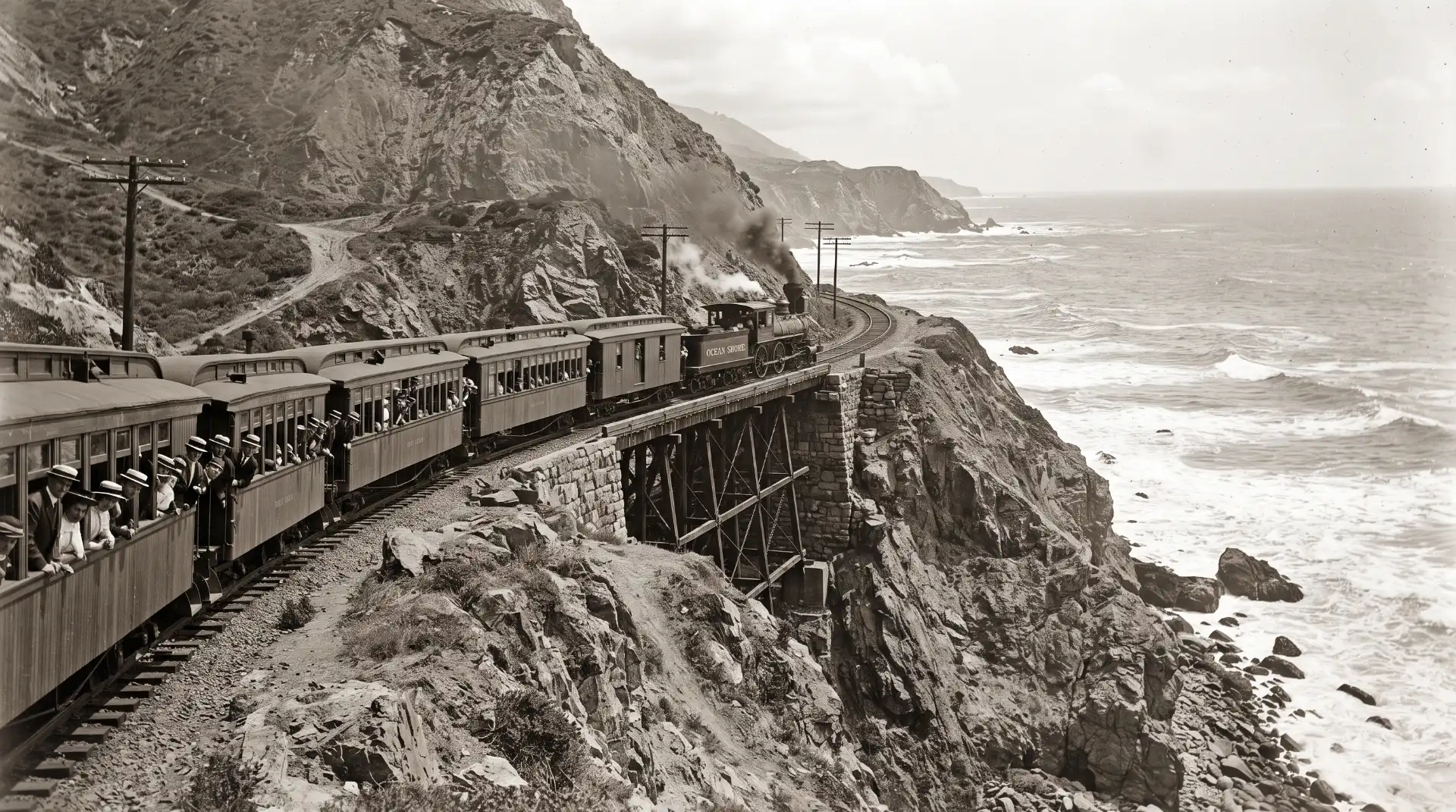
The Coastside and the Ocean Shore Railroad
Transportation development did not occur at the same pace across every part of San Mateo County. The eastern Peninsula, with its relatively accessible north-south corridor, was easier to connect than the rugged Pacific Coast. Coastside communities faced steep terrain and difficult routes across the Santa Cruz Mountains, creating a long-standing transportation challenge.
The Ocean Shore Railroad represents one of the most ambitious attempts to solve that problem. During the early twentieth century, developers envisioned a railroad connecting San Francisco with the Pacific Coast and eventually extending toward Santa Cruz. Such a route could have dramatically changed the Coastside by improving access for residents, businesses, farmers, and tourists.
Construction began, but the project encountered serious challenges. The rugged coastline required expensive engineering, including tunnels, cuts, trestles, and other structures. The 1906 San Francisco earthquake caused additional damage and contributed to financial difficulties surrounding the project. Although portions of the railroad operated, the larger vision of a continuous coastal railway was never completed.
The history of the Ocean Shore Railroad demonstrates how transportation projects could be shaped by geography and natural disasters. Engineers could design routes, investors could provide money, and communities could support development, but the physical landscape remained a powerful force. The cliffs and mountains that made the Coastside beautiful also made transportation infrastructure expensive and difficult to maintain.
The railroad’s unfinished history nevertheless remains important because it reveals how transportation was viewed as a tool for economic development. Improving access to the Coastside could open new markets, encourage tourism, and support communities that had previously been relatively isolated. Even when a transportation project failed to achieve its original goal, the effort could influence later decisions about roads and infrastructure.
The Automobile Creates a New Kind of Mobility
The next major transformation came with the rise of the automobile. Cars offered something that railroads and streetcars could not provide: flexibility. A train or streetcar had to follow a fixed route, but an automobile could travel wherever suitable roads existed. As vehicle ownership increased, transportation development increasingly focused on improving roads and creating connections between communities that were not directly served by rail.
San Mateo County became an important location in California’s early highway development. Historical records from the county describe the construction of an early section of the California State Highway System between San Bruno and Burlingame beginning in 1912. This development reflected a broader shift toward government-supported road infrastructure as automobile travel became more important.
Improved roads affected nearly every part of local life. Farmers could transport products to markets more efficiently. Businesses could receive supplies from farther away. Residents could travel between communities without relying entirely on railroad or streetcar schedules. Visitors could reach areas that previously required more difficult journeys.
The automobile also changed residential development. A home no longer needed to be within walking distance of a railroad station or streetcar line to be practical for commuters. New neighborhoods could be developed farther from traditional transportation corridors, provided that roads connected them with employment and commercial centers.
This created a new form of suburban expansion. Instead of growth spreading primarily along rail and streetcar lines, development could increasingly follow a network of roads. The result was a more dispersed pattern of communities across the Peninsula.
Highways Connect San Mateo County to the Bay Area
The automobile’s influence became even greater after World War II, when population growth, suburban development, and economic expansion transformed the Bay Area. San Mateo County became increasingly connected to San Francisco, the South Bay, and communities across the region. Major highways provided the infrastructure needed to support growing numbers of commuters, businesses, and residents.
U.S. 101 became one of the most important transportation corridors through the Peninsula. The highway connected communities from San Francisco through San Mateo County and into the South Bay, becoming essential to both personal travel and commercial activity. Interstate 280 provided another major north-south route, while other roads and bridges connected the county to neighboring parts of the Bay Area.
The growth of highway infrastructure had enormous consequences for the county. Businesses could operate across larger geographic areas, workers could travel greater distances, and communities could expand beyond the older railroad and streetcar corridors. San Mateo County became increasingly integrated into the larger metropolitan economy of the Bay Area.
Transportation was now operating at a much larger scale than it had in the nineteenth century. Early roads had primarily connected individual communities and moved agricultural or natural resources to market. Railroads created regional connections. Highways helped create a metropolitan transportation network in which San Mateo County functioned as a major link between San Francisco and the South Bay.
Bridges were equally important to this regional development. The Dumbarton Bridge, for example, created an important connection across the southern portion of San Francisco Bay. By improving access between the Peninsula and communities east of the Bay, such transportation infrastructure helped expand the economic geography of the region.
Transportation and the Growth of Modern San Mateo County
By the second half of the twentieth century, San Mateo County had become a densely connected suburban and urban region. The county’s transportation system reflected its changing population and economy. Automobiles remained essential, but increasing congestion created demand for public transportation and alternative ways to travel.
Modern transit systems developed as part of this changing landscape. Caltrain continued the Peninsula’s long railroad tradition, while SamTrans provided bus transportation across the county. BART also became an important regional connection for communities in northern San Mateo County. These systems provided alternatives to driving and helped connect residents with employment centers, schools, shopping districts, airports, and other destinations.
What makes San Mateo County’s transportation history particularly interesting is the continuity between past and present. The railroad corridor established in the nineteenth century remains important today. Some modern roads occupy routes that developed from much older transportation patterns. Communities that grew around railroad or streetcar stations remain major population centers.
Modern transportation therefore did not replace the county’s earlier transportation history. Instead, it built upon it.
The reasons people travel have changed, but the basic need remains the same. People need to reach jobs, businesses need to move goods, and communities need connections with neighboring areas. Transportation infrastructure remains one of the foundations of the county’s economy.
How Transportation Shaped Local Communities
The history of San Mateo County demonstrates that transportation can influence the identity of individual communities. Redwood City developed partly through its relationship with the timber industry and waterfront transportation. San Mateo and other Peninsula communities benefited from railroad and streetcar connections with San Francisco. Coastside communities developed under the constraints created by mountains and difficult coastal terrain.
Transportation also influenced the location of commercial districts. Businesses wanted to be close to customers, and customers often gathered around transportation routes. Railroad stations, streetcar stops, waterfront facilities, bridges, and highways could all become focal points for economic activity.
Residential development followed similar patterns. People generally wanted convenient access to transportation, particularly when commuting became an important part of daily life. As transportation technology changed, the definition of a convenient location changed with it.
During the railroad era, living near a station was particularly valuable. During the streetcar era, access to a local line became important. During the automobile era, proximity to major roads and highways became increasingly significant. Today, many residents consider access to both roads and public transportation when choosing where to live.
These changes help explain why modern San Mateo County contains communities with very different physical layouts. Some neighborhoods retain the compact character associated with earlier transportation systems, while others reflect decades of automobile-oriented development.
The Landscape Still Reveals the Transportation Past
Although modern San Mateo County can appear highly developed, evidence of its transportation history can still be found throughout the region. Historic roads, railroad corridors, bridges, station sites, waterfront areas, trails, and preserved buildings can provide clues about how people moved through the county in earlier generations.
The natural landscape also helps explain transportation decisions. The Santa Cruz Mountains, Pacific cliffs, valleys, and waterways influenced where transportation infrastructure could be built. In some areas, roads and railroads followed natural valleys because they offered easier grades. In other places, engineers had to build bridges, tunnels, or cuts to overcome difficult terrain.
The history of transportation is therefore closely connected to the natural history of the Peninsula. The geological forces that shaped the mountains and coastline long before human settlement eventually influenced the routes people used to move through the region.
For readers interested in that deeper history, the existing SMC History article “What Ancient Fossils Reveal About San Mateo County” provides a useful connection between the ancient landscape and the region that later became home to roads, railroads, farms, and communities.
Understanding the natural landscape can make transportation history easier to understand. A road that appears unusual on a modern map may make more sense when viewed against the mountains and valleys that surround it. A coastal route may appear difficult until the historical need for access to isolated communities is considered.
From Lumber Routes to a Modern Transportation Network
The transformation of San Mateo County from a redwood-producing region into a major part of the Bay Area economy occurred over many generations. Transportation was one of the central forces behind that transformation.
During the nineteenth century, roads and waterways connected the redwood forests with Redwood City and San Francisco. The railroad then created a faster and more reliable connection between the Peninsula and the region’s major urban centers. Streetcars expanded local mobility and encouraged residential development beyond traditional town centers.
The automobile introduced another major change by allowing people to travel beyond fixed rail routes. Roads and highways expanded, connecting communities throughout the Peninsula and linking San Mateo County with the larger Bay Area. Bridges strengthened connections across San Francisco Bay, while modern public transportation provided alternatives as population density and traffic increased.
Each stage of transportation history influenced the next.
The roads created during the logging era helped establish early connections between communities. Railroad corridors followed and strengthened those connections. Streetcars expanded them into neighborhoods. Automobiles created new patterns of suburban growth. Highways turned the Peninsula into an important part of a regional metropolitan transportation network.
The story is not simply one of technological progress. It is a story about changing human needs and the ways communities respond to those needs.
Preserving the Transportation History of San Mateo County
Transportation history is worth preserving because it provides a different way to understand local communities. A historic railroad station is not simply an old building. It can represent the moment when a community became connected to a larger regional economy. An old road may reveal how farmers once transported their products. A waterfront structure may preserve the memory of the timber trade that helped build early Peninsula communities.
Historical photographs, maps, newspapers, railroad schedules, business records, artifacts, and oral histories can help researchers reconstruct these stories. Institutions such as the San Mateo County Historical Association preserve important materials that allow residents and researchers to study how the county changed over time.
Preserving this history also helps modern residents understand why the county looks the way it does today. Modern highways and transit systems can seem inevitable when viewed without historical context, but they were the result of generations of decisions. Communities selected routes, built infrastructure, responded to economic changes, dealt with natural disasters, and adapted to new technologies.
The transportation landscape is therefore a historical record in itself.
A County Built Around Connection
From the redwood forests to the railroad tracks, from wagon roads to highways, the history of San Mateo County is fundamentally a history of connection. Transportation allowed natural resources to reach markets, helped communities communicate with one another, encouraged residential development, supported economic growth, and connected the Peninsula to the larger Bay Area.
The redwoods created an early need for transportation. Lumber had to leave the mountains and reach the waterfront. Railroad technology then changed the scale of movement, making it possible for people and goods to travel more efficiently between San Francisco and the Peninsula. Streetcars expanded that mobility, while automobiles and highways eventually created an even broader network.
Modern San Mateo County still carries the imprint of those earlier transportation decisions. The railroad corridor remains an important part of the Peninsula. Major highways follow routes that connect communities across the region. Older downtowns continue to reflect the influence of railroad and streetcar development, while Coastside roads reveal the continuing challenge of navigating the county’s mountains and coastal terrain.
Transportation has never been simply about getting from one place to another. It has always been about creating relationships between places.
That is why the history of transportation is so important to understanding San Mateo County. The roads, railways, bridges, trails, and transit systems that cross the Peninsula are physical reminders of how earlier generations responded to the challenges and opportunities of their time.
The county’s story began with forests, farms, waterways, and scattered settlements. As transportation improved, those places became increasingly connected. The result was the San Mateo County we recognize today: a diverse Peninsula region whose communities are linked by an intricate network of roads, railways, transit lines, bridges, trails, and highways.
From the movement of redwood logs through mountain forests to modern commuters traveling along the Peninsula, transportation has helped shape where people live, where businesses operate, and how communities interact. The technologies have changed dramatically, but the fundamental story remains the same. San Mateo County grew because people found new ways to connect its landscapes and communities, and those connections continue to shape its history today.