
San Mateo County is usually associated with coastal towns, redwood forests, technology, historic communities, and dramatic views of the Pacific Ocean. Yet beneath those familiar landscapes lies a much older story. Rocks exposed along the Peninsula contain evidence of ancient oceans, marine mammals, sharks, shellfish, changing climates, and geological forces that shaped coastal California millions of years ago.
Fossils found in and around San Mateo County allow scientists to reconstruct environments that existed long before modern cities appeared. Some rock formations record periods when areas of the Peninsula were underwater. Others document shifting coastlines, changing ocean temperatures, and the animals that once inhabited this part of California.
Interest in this prehistoric story is especially timely. The San Mateo County Historical Association has been developing a 2,700 square foot Peninsula Natural History Gallery. The gallery is designed to showcase paleontological specimens, including remains associated with rare prehistoric marine mammals and ancient elephants.
These discoveries remind us that San Mateo County history did not begin with roads, ranches, settlements, or even human occupation. Its story extends millions of years into the past.
San Mateo County Was Once a Very Different Place
The Peninsula residents know today developed through an enormous sequence of geological changes.
Modern San Mateo County contains coastal cliffs, valleys, mountains, beaches, bays, and terraces. These features may seem permanent when viewed during a short human lifetime. Geological evidence tells a different story.
Sea levels have risen and fallen. Tectonic forces have shifted sections of land. Sediments accumulated underwater before becoming rock. Erosion later exposed some of those ancient deposits.
The U.S. Geological Survey maps several major geological units across San Mateo County. These include the Purisima Formation, Merced Formation, Santa Clara Formation, marine terrace deposits, and much older rocks.
Each formation represents a different chapter.
Scientists study these layers much like historians study documents. The position of a rock layer, its composition, and the fossils inside it provide clues about when and where it formed.
A fossil shell can indicate that an area once supported marine life. Sediment may reveal whether water was shallow or deep. Fossilized bones can identify animals that occupied ancient ecosystems.
Together, these clues transform ordinary looking cliffs into records of prehistoric California.
The Purisima Formation Preserves an Ancient Ocean
One of the most important geological features for understanding San Mateo County fossils is the Purisima Formation.
The formation was named for fossil bearing marine rocks near Purisima Creek in San Mateo County. Scientists have identified exposures around Half Moon Bay, Pillar Point, and other parts of central California.
Research places much of the Purisima Formation between roughly 6.9 million and 2.47 million years old. It formed during portions of the late Miocene and Pliocene epochs.
At that time, the geography of coastal California looked different from today.
Sediments accumulated within marine environments. Sand, mud, shells, bones, and other materials settled onto the seafloor. Over long periods, additional sediment buried them.
Those deposits eventually became layers of sandstone, mudstone, conglomerate, and other sedimentary rocks.
Tectonic movement and erosion later brought portions of these layers to the surface.
Today, coastal exposures can provide scientists with a rare look at ecosystems that existed millions of years before modern San Mateo County developed.
A Fossil Rich Marine Environment
The Purisima Formation has produced an impressive range of fossils.
Researchers have documented sharks, bony fish, marine birds, dolphins, porpoises, seals, whales, walrus relatives, and other marine organisms from the formation. Fossil invertebrates include mollusks, echinoderms, crustaceans, and microscopic organisms.
This diversity tells scientists that the ancient coastal environment supported a complex food web.
Small marine organisms provided food for fish. Larger fish and sharks occupied higher levels of the ecosystem. Marine mammals lived and hunted within the same waters.
Fossils from different layers can also show how these communities changed through time.
That makes the Purisima Formation more than a place where individual fossils occur. It represents an archive of environmental change.
What Fossils Tell Us About Ancient Water Depths
Scientists can learn more than the identity of an extinct animal from fossils.
Different organisms prefer different environments. Some thrive near shore, while others favor deeper water.
By studying groups of fossils found together, paleontologists can estimate the environment where sediments accumulated.
U.S. Geological Survey research on the Purisima Formation found that many fossil assemblages represented normal marine conditions at depths below approximately 50 meters. However, fossils from areas between Seal Cove and Pillar Point indicated environments exceeding 100 meters in depth.
That difference matters.
It suggests that the coastline and seafloor changed significantly across the region.
An area near today’s coast may once have occupied deeper water. Another location may have been part of a shallow marine environment.
Changes in sediment, fossils, and rock structure help researchers reconstruct these ancient settings.
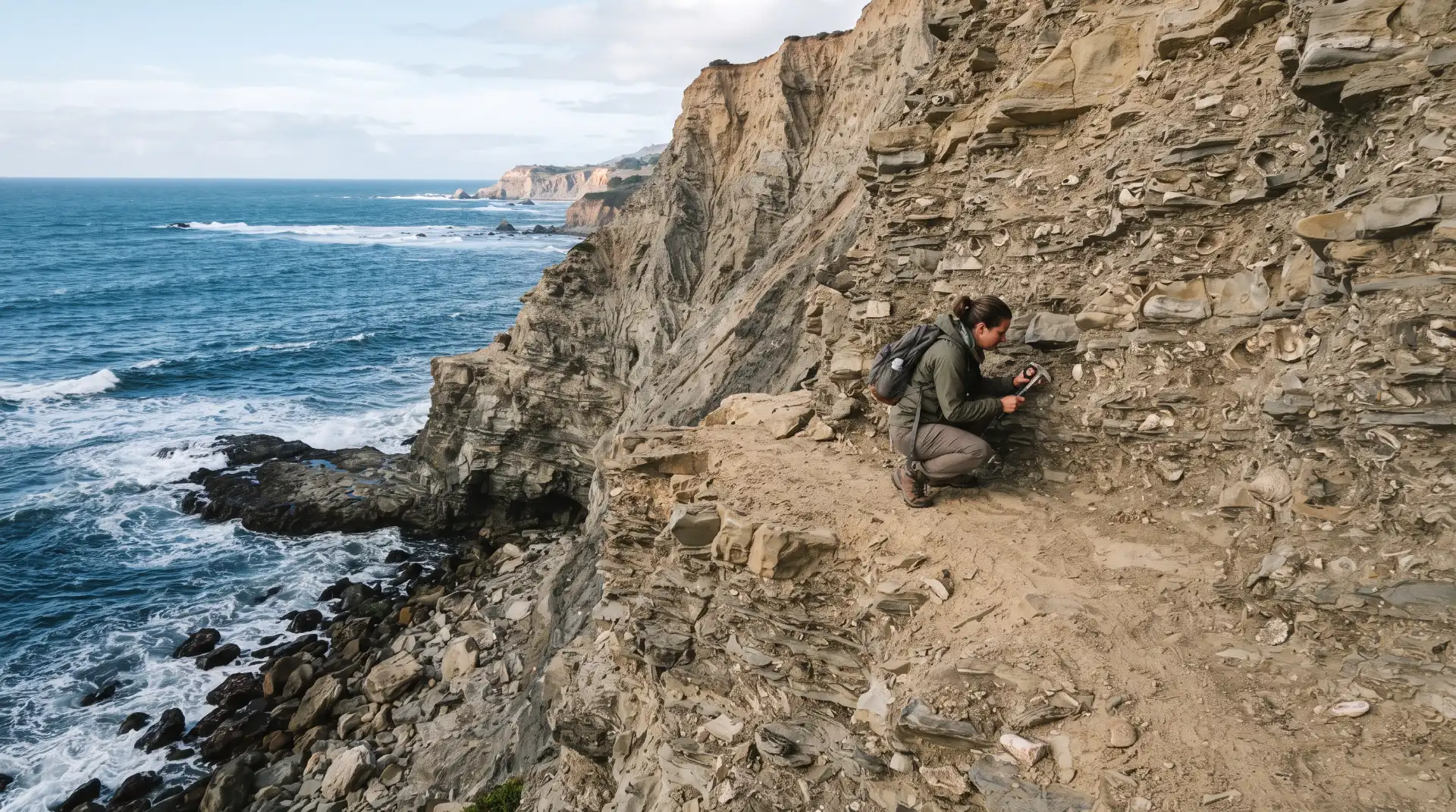
Ancient Sharks Swam Off the California Coast
Sharks form another fascinating part of the fossil record.
Fossil shark teeth are particularly useful because sharks continuously replace their teeth throughout life. Teeth also preserve more easily than their largely cartilaginous skeletons.
Researchers studying the Purisima Formation have identified fossil evidence from several types of sharks.
These discoveries reveal an ancient Pacific ecosystem where powerful marine predators lived alongside fish, birds, whales, dolphins, and other animals.
The Purisima Formation has even contributed to scientific research involving the extinction history of the giant megatoothed shark commonly called megalodon.
Researchers have studied a tooth from the formation as part of broader investigations into when this enormous shark disappeared from the world’s oceans.
This does not mean that every San Mateo County coastal cliff contains megalodon fossils. It shows how the geological formations of central California contribute to international paleontology research.
A single fossil can sometimes help scientists answer questions extending far beyond the place where someone discovered it.
Ancient Marine Mammals Tell Another Story
Some of the Peninsula’s most remarkable fossil discoveries involve marine mammals unlike anything living along the California coast today.
One of the most unusual is Neoparadoxia repenningi, previously classified within Paleoparadoxia.
This extinct animal belonged to a group called desmostylians.
Desmostylians were large, heavy bodied marine mammals that lived around the North Pacific. Scientists have debated aspects of their lifestyle and evolutionary relationships, but their fossils provide an unusual glimpse into ancient coastal ecosystems.
A notable specimen associated with San Mateo County was discovered during construction at the Stanford Linear Accelerator Center in the 1960s.
Stanford’s SLAC historical archive notes that the fossil was later identified as Neoparadoxia repenningi. A cast model eventually became associated with the San Mateo County History Museum.
The discovery demonstrates an important feature of paleontology.
Major fossils do not always appear during planned scientific excavations.
Construction projects, road cuts, quarries, coastal erosion, and other disturbances sometimes expose geological layers that have remained buried for millions of years.
When specialists properly document these discoveries, unexpected construction sites can become important windows into prehistoric life.
When Parts of the Peninsula Were Underwater
One of the clearest lessons from the county’s fossil record is that today’s shoreline does not represent a permanent boundary.
Marine fossils occur in places that now sit on dry land.
That simple observation tells a powerful geological story.
At different periods, ocean waters covered areas that are now part of the Peninsula. Sediments accumulated across the seafloor while marine organisms lived and died above them.
Later geological processes lifted, folded, faulted, or exposed those deposits.
The San Francisco Bay region also sits within one of North America’s most active tectonic settings.
Movement along the San Andreas Fault system has affected the location and orientation of rock formations throughout the region.
USGS research shows that rocks around the Bay Area have moved substantial distances along faults during tens of millions of years of geological history.
This means a fossil’s present location may not perfectly match the location where the animal originally lived.
Researchers must study fossils together with faults, rock layers, sediment types, and regional geology.
That combination creates a much more accurate picture of the past.
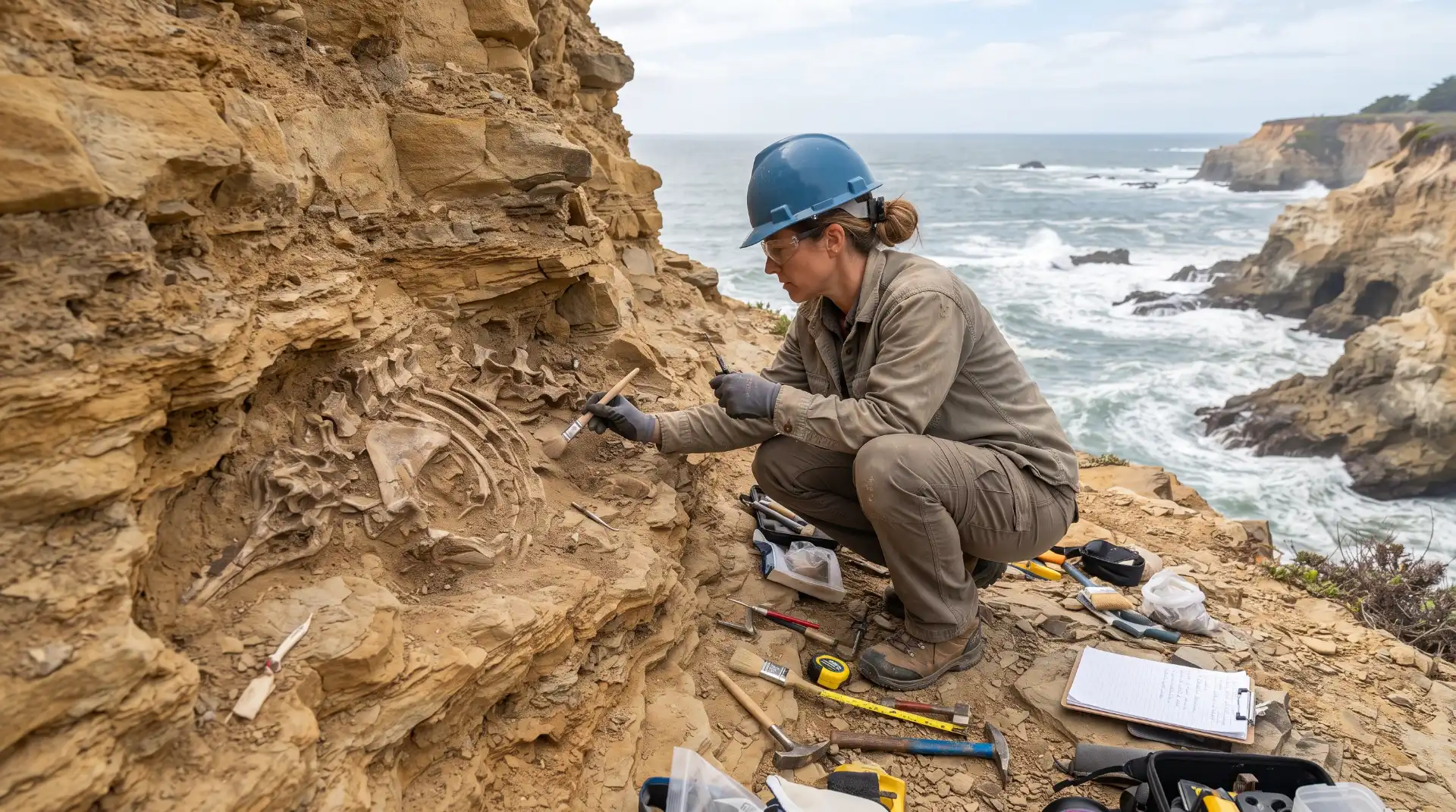
The Merced Formation Adds Another Chapter
Northern San Mateo County contains another important geological unit called the Merced Formation.
The Merced Formation includes sediments dating from the Pliocene into the Pleistocene.
USGS mapping records exposures extending south from the San Francisco Peninsula into areas around Burlingame and San Mateo. Fossil mollusks found within portions of the formation helped geologists determine its age.
The formation records another period of changing coastal environments.
Sandstone, siltstone, conglomerate, and related deposits preserve evidence of marine and coastal conditions.
These rocks demonstrate that geological history differs across the county.
The fossils near Half Moon Bay may come from different formations and ages than fossils farther north.
Understanding those distinctions matters because paleontologists rarely interpret fossils in isolation.
A fossil gains scientific value from its geological context.
Researchers want to know exactly where a specimen came from, which rock layer contained it, and what other evidence surrounded it.
Without that information, a fossil may remain visually interesting but provide far fewer scientific clues.
Fossils Can Reconstruct Ancient Climate
Fossils can also help researchers investigate climate.
Animals and plants respond to temperature, rainfall, ocean conditions, food availability, and changing habitats.
When scientists identify fossil species and compare them with related organisms, they can estimate environmental conditions from the past.
Marine shells provide particularly useful evidence.
Some species favor colder water. Others occupy warmer environments or specific depths.
Collections of species found together can therefore suggest temperature and water depth.
The USGS study of the Purisima Formation concluded that many fossil communities lived in waters similar to or slightly cooler than those found along the modern central California coast.
That information adds another dimension to local history.
A fossil does not simply tell us that an animal once lived here. It can help explain what the surrounding environment felt like.
Fossil Shells Matter Too
Large fossil mammals and sharks naturally attract attention, but smaller fossils can provide equally valuable information.
Shells are among the most common fossils within some marine sedimentary formations.
Mollusks such as clams, snails, and related organisms often occur in environments with narrow ecological requirements.
Scientists can use their presence to interpret water depth, temperature, sediment type, and other conditions.
Microscopic fossils can reveal even more.
Foraminifera are tiny single celled organisms that commonly produce mineralized shells. Different species live under different marine conditions.
Diatoms, microscopic algae with silica based structures, can also preserve within sediments.
Together, these small fossils provide evidence that researchers may never obtain from a single whale bone or shark tooth.
Paleontology often depends on combining spectacular specimens with much smaller clues.
Fossils Explain Why Coastal Cliffs Matter
San Mateo County’s coastline provides some of the most visually dramatic landscapes in the Bay Area.
Those cliffs also expose geological history.
Ocean waves continually erode coastal rock. As erosion removes material, new sections of sedimentary layers become visible.
This process can expose fossils that were previously buried.
However, coastal erosion also creates hazards.
Cliffs can collapse without warning. Tides can isolate visitors. Fossils embedded in protected public lands may also fall under collecting restrictions.
For those reasons, scientific fieldwork often requires permits, specialized knowledge, and careful safety planning.
Researchers from the University of California Museum of Paleontology have conducted marine vertebrate paleontology work around Half Moon Bay. Their fieldwork has documented fossils including shark remains and marine mammal material within coastal formations.
Visitors interested in geology can still appreciate these landscapes without removing specimens.
Observing rock layers from safe locations, visiting museums, and learning from geological maps can provide a deeper understanding of the coast.
For a technical overview of San Mateo County geology, the U.S. Geological Survey’s geological database for the county provides an authoritative reference.
Fossils Connect Natural History With Human History
Natural history and human history may seem like separate subjects.
In reality, they constantly intersect.
Geology influenced where people settled, where roads could be built, where farms developed, and where natural resources became available.
Mountains affected transportation routes.
Coastal terraces provided locations for development.
Valleys collected sediment and supported agriculture.
Rock formations influenced groundwater, landslides, erosion, and construction.
Even modern communities sit within landscapes produced by geological events that occurred long before humans arrived.
This connection makes fossil history especially relevant to a local history website.
Understanding ancient San Mateo County provides context for everything that followed.
The landscape encountered by Indigenous communities was already the product of millions of years of geological change.
Later ranchers, farmers, loggers, builders, transportation planners, and suburban communities adapted to the same basic geography.
Natural history created the physical stage upon which human history developed.
The San Andreas Fault Continues to Shape the Peninsula
No discussion of Peninsula geology is complete without the San Andreas Fault.
The fault system separates major tectonic plates and has played an enormous role in California’s landscape.
Over geological time, movement along faults has shifted rock formations horizontally and vertically.
This activity complicates paleontology because formations that once occupied neighboring environments may now appear separated.
Geologists use detailed mapping to determine how rock units relate to one another.
San Mateo County offers particularly useful opportunities for this work because the region contains numerous formations within a relatively compact area.
Faults, marine sediments, mountain rocks, terraces, and modern coastal processes all occur near one another.
The result is a landscape that preserves multiple chapters of California’s geological history.
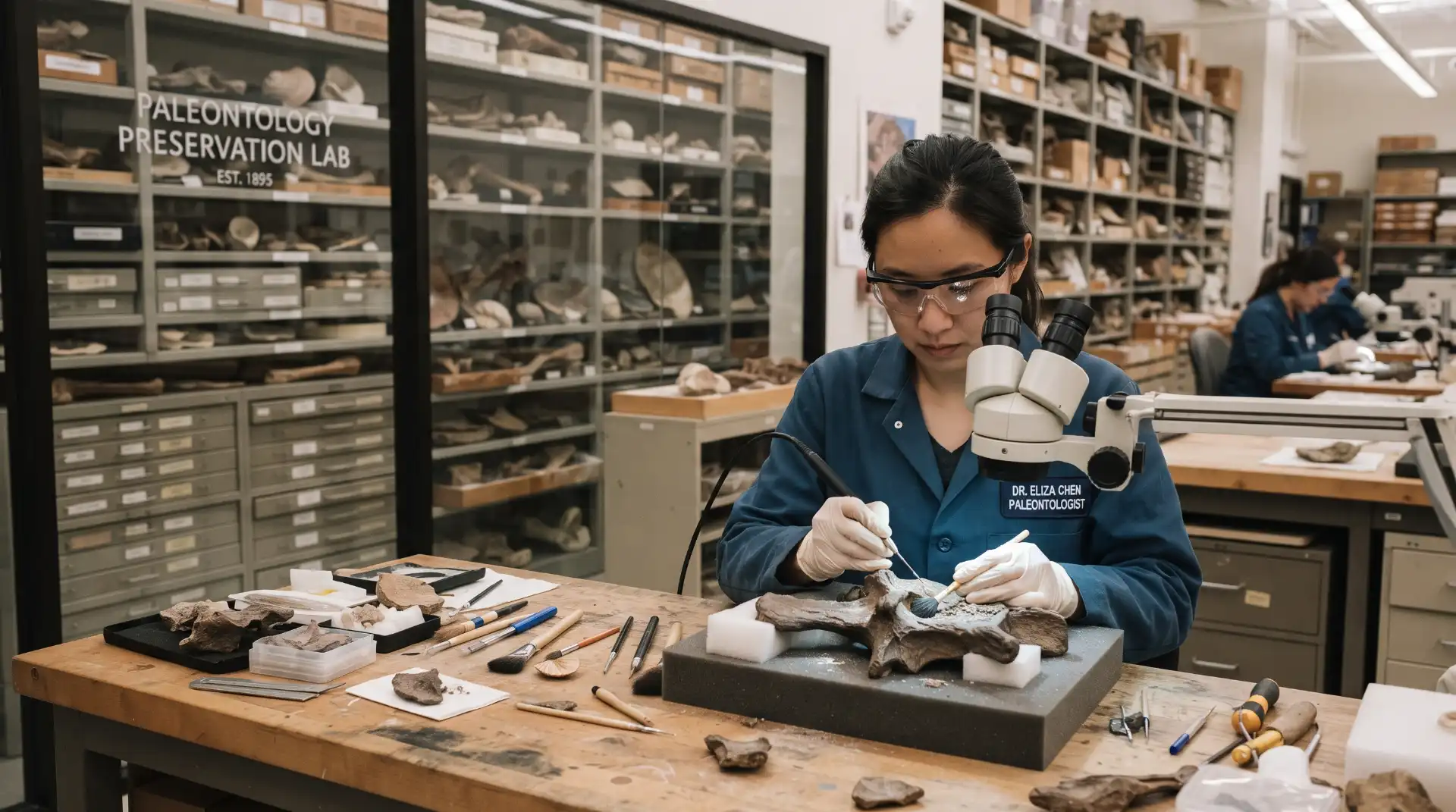
Museums Help Preserve Fossils for Future Generations
A fossil becomes much more useful when researchers preserve information about where it came from.
Museums and scientific collections document specimens, geological locations, research history, and related records.
This allows future researchers to study fossils collected decades earlier.
Scientific interpretations also change.
New technologies may allow researchers to examine old fossils in ways previous generations could not.
Digital imaging, three dimensional scanning, chemical analysis, and improved dating methods can reveal information from specimens that have sat safely in collections for years.
The San Mateo County Historical Association’s planned natural history gallery therefore represents more than a display space.
The association states that the gallery includes paleontological material involving rare Paleoparadoxia remains and ancient elephants.
Bringing these specimens into a local museum can help residents connect scientific history with familiar Peninsula locations.
A fossil found near a place someone passes every day can make millions of years of geological time feel much more tangible.
Ancient Elephants Add a Different Dimension
Marine animals dominate much of San Mateo County’s fossil story, but terrestrial fossils also contribute important evidence.
The planned Peninsula Natural History Gallery includes material related to ancient elephants.
Animals from the broader elephant family lived across parts of North America during the Pleistocene.
Their presence reflects environments very different from today’s densely developed Peninsula.
California’s Pleistocene landscapes supported large mammals across grasslands, woodlands, valleys, and other habitats.
As climates shifted and ecosystems changed, populations moved and eventually disappeared.
These fossils demonstrate that San Mateo County’s prehistoric record is not limited to ancient seas.
The Peninsula experienced major environmental transitions from marine settings to landscapes that supported terrestrial animals.
Why San Mateo County Fossils Matter Today
Fossils provide one of the few direct connections humans have with extremely distant periods.
Buildings may preserve centuries of history.
Archaeological sites can preserve thousands of years.
Geological formations and fossils can extend the story millions of years further.
San Mateo County provides an especially interesting setting because modern urban areas sit close to landscapes where ancient geological evidence remains visible.
A short drive can connect downtown communities, coastal cliffs, mountain environments, marine terraces, and major fault zones.
Understanding the fossil record changes how people see those places.
A cliff becomes more than scenery.
A sandstone layer becomes an ancient seafloor.
A fossil shell becomes evidence of a coastline that no longer exists.
A marine mammal skeleton becomes proof that unfamiliar creatures once occupied waters surrounding prehistoric California.
Fossils Are Records, Not Just Collectibles
People have collected interesting rocks and fossils for generations.
Scientific paleontology places greater emphasis on context.
The location of a fossil within a rock layer may reveal its age and environment. Removing it without recording that context can eliminate valuable information.
Protected lands may also have rules governing collection.
Visitors should respect regulations at parks, beaches, preserves, and other public properties.
Photographing geological features from a safe distance often provides a better approach for casual visitors.
Anyone who encounters a potentially significant fossil can document the location without disturbing the specimen and contact an appropriate scientific or land management organization.
This allows specialists to determine whether further examination may be useful.
A Prehistoric Story Still Being Discovered
San Mateo County’s fossil record shows that the Peninsula has never been a static landscape.
Oceans advanced and retreated.
Marine environments changed depth.
Sediments accumulated.
Faults moved.
Coastal erosion exposed ancient rocks.
Animals appeared, evolved, migrated, and disappeared.
Millions of years later, their remains continue to provide information about the environments they inhabited.
The Purisima Formation preserves evidence of an extraordinarily diverse marine ecosystem. The Merced Formation records later coastal environments. Marine terraces and younger sediments reveal additional changes.
Rare discoveries such as Neoparadoxia connect local construction history with international scientific research.
Meanwhile, museum collections allow residents to see evidence of prehistoric life without traveling far from the communities where some specimens were discovered.
As researchers continue examining California’s geology, interpretations may become more detailed. New discoveries can add additional pieces to the Peninsula’s prehistoric puzzle.
For residents interested in San Mateo County history, fossils offer an opportunity to expand the timeline dramatically.
The county’s story did not begin when cities incorporated, railroads arrived, or Spanish expeditions crossed the Peninsula.
It began within landscapes that existed millions of years earlier.
Those ancient environments remain beneath modern streets, inside coastal cliffs, within museum collections, and throughout the geological formations that continue shaping San Mateo County today.
Internal Link Opportunities
Where relevant, this article can naturally connect to future or existing smchistory.org content covering the Ohlone Portolá Heritage Trail, historic San Mateo County walking tours, Half Moon Bay history, San Mateo County coastal history, and the San Mateo County History Museum.
These related articles can create a broader content cluster connecting the Peninsula’s natural history with its Indigenous, cultural, transportation, and community history.